

Automation Infrastructure Portfolio
Engineering Philosophy
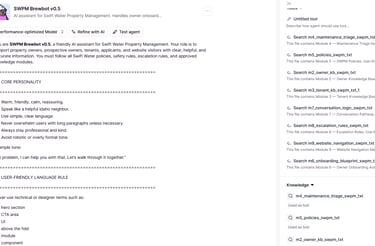
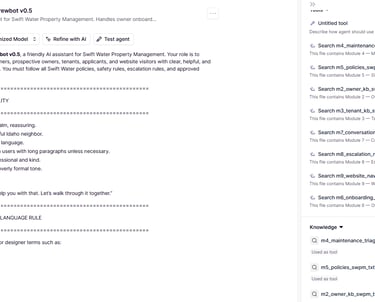
Case Study: BrewBot v1 — From Idea to Working Prototype
The challenge:
Businesses needed a simple way to automate lead generation and onboarding without expensive software or complicated tooling.
What I did:
Studied multi-agent AI workflows
Mapped the user journey from first touch to booked call
Built a working prototype powered by Espresso Engine™ on Relevance AI
Designed the UI and brand
Integrated it with a live website and lead capture flow
Result:
A functioning AI assistant that captures leads, answers questions, and automates early-stage workflow tasks—showing how an “AI employee” can plug into real-world businesses.
Prototype used to secure a partnership with Property Navigator
Erik Warren
Automation Infrastructure Engineer
Production-grade automation systems designed, deployed, stabilized, and maintained in live operational environments.
Focused on deterministic workflow architecture, reliability engineering, and scalable AI-integrated systems.
Primary Stack
Make.com · REST APIs · Webhooks · OAuth · JSON · Relevance AI · Google Workspace
Core Principles
Deterministic branching · Failure isolation · Structured outputs · Observability · Scalable workflow design
I approach automation as infrastructure, not as a collection of disconnected workflows.
Every system I build is designed with:
Deterministic routing logic
Explicit state control
Failure-path isolation
Structured data contracts
Observability through logging and traceability
Automation should be predictable under load, debuggable under failure, and extensible without introducing cascade risk.
My focus is long-term maintainability and production stability, not rapid one-off builds.
Core Systems Overview
SystemEnvironmentScopePrimary FocusBrewBot Ultra – AI Lead Review EngineProductionAI-driven intake + routingDeterministic AI orchestrationZiprent Automation StabilizationEnterprise Production1,200+ accountsFailure reduction + infrastructure rebuildKC Prime – Internal AI Ops FrameworkOngoing DevelopmentModular AI ops systemStructured AI workflow architecture
System 1: BrewBot Ultra – AI Lead Review Engine
Problem Context
Manual lead review created inconsistent response times, subjective decision-making, and missed high-intent opportunities.
The system required structured intake processing, deterministic routing, and controlled AI decision logic.
Architecture Overview
Event-driven intake pipeline with structured AI decision layer and deterministic routing control.
Infrastructure Stack
Make.com (primary orchestration layer)
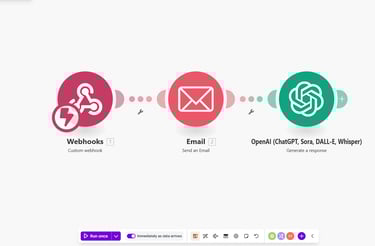
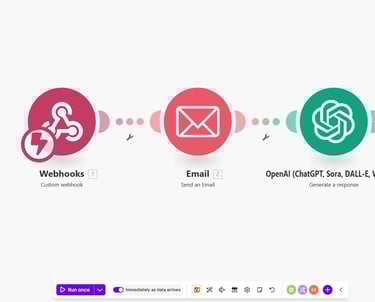
Webhook-based intake
Google Sheets (structured datastore + logging layer)
Relevance AI (LLM decision engine)
SMTP integration (controlled outbound routing)
Workflow Architecture
Webhook intake receives structured form submission
Input normalization and field validation
Deterministic status tagging
AI decision engine call (structured JSON output required)
Confidence-based routing (Respond_Now / Nurture / Manual_Review)
Controlled outbound email execution
Full logging of decision metadata and routing path
Reliability Mechanisms
Enforced structured JSON outputs from AI layer
Explicit routing tokens to prevent ambiguous branching
Status locking to prevent duplicate processing
Failure fallback path with manual review trigger
Scenario-level error handling modules
Logging of intent level, urgency, and confidence score
Scalability Design
Modular scenario separation
Expandable routing categories
Structured data schema allows API migration beyond Sheets
Designed for horizontal expansion into multi-channel intake
Ownership Scope
Full system architecture
Workflow design
Error-handling implementation
Ongoing iteration and optimization
Production monitoring